HAVN HS 360 VGPU Review: Rear-Connect Support in a Smaller, Lighter Case
The £239.99 HS 360 VGPU is solid, supports rear-connection boards and weighs less than the HS 420, but it costs more without including fans.
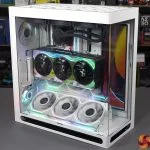
HAVN’s HS 360 VGPU makes a cleaner PC build easier to achieve, thanks to support for rear-connection motherboards and a cable-routing system designed to keep wiring out of sight. It’s also smaller and lighter than the HS 420. The trade-offs are a £239.99 price, no included fans and a few VGPU-specific parts that made little difference in cooling tests.
The HS 360 resembles the HS 420, but the change in size brings a different set of fan options. It supports 120mm fans throughout and drops support for 140mm models. HAVN says it’s 19.4% smaller and 29.5% lighter than the HS 420. In the review, the bare case weighed 15kg, down from 19kg. That’s a meaningful reduction for a case this large, though 15kg is still substantial before components are installed.


Room for a concealed build
Rear-connection ATX, Micro-ATX and Mini-ITX motherboards are supported, letting builders connect many cables behind the board instead of across its visible face. That pairs naturally with HAVN’s SimpliCable routing system: the case is built around hiding wiring and keeping the main chamber visually tidy.
Other details support the same premium, showpiece approach. The panoramic UniSheet glass has a tighter bend radius than the HS 420, and HAVN says the case has improved structural strength. Removable components use anti-vibration design, while the fan bracket has been refined to allow rear fan installation. The glass panel’s curved shape is a prominent part of the design, so careful handling remains sensible during a build.


The VGPU version adds an integrated magnetic Airflow Divider, intended to direct air toward a vertically mounted graphics card. The review also tested a glass guide that feeds air to the card. Neither feature made a convincing case for itself in the results: the guide had only a small effect, and the divider brought no measurable cooling benefit in the reported tests. The reviewer’s view was that removing those pieces could simplify assembly and might reduce the case’s cost.
There’s generous space for cooling hardware. The roof, side and floor each take a radiator up to 360mm, while fan mounts accommodate three 120mm fans at the roof, side and floor, plus two at the rear. HAVN supplies no fans, so buyers need to include them in their build plan and budget. The review’s strong cooling results came from a system fitted with a 360mm liquid cooler and eight 120mm fans; they shouldn’t be read as a result from the bare case alone.


Cooling and build details
For its thermal testing, KitGuru used an AMD Ryzen 7 9850X3D with a Palit RTX 5080 GameRock OC 16GB graphics card. The rest of the system included a Fractal Design Radius 360 CPU cooler, Lian Li UniFan TL Wireless LCD 120 case fans, an MSI MAG X870E Tomahawk Max WiFi PZ motherboard, 32GB of G.Skill Trident Z5 NeoX RGB memory, a Montech Titan PLA 1000W power supply and a Crucial T700 Gen 5 M.2 NVMe SSD, running Windows 11.
The reviewer found the HS 360 VGPU performed well under that test setup, which produced substantial heat. The result supports the case’s cooling potential when it’s populated with a large radiator and multiple fans. But the special airflow pieces didn’t add a clear advantage, and buyers should factor in the extra hardware needed to reproduce the review’s configuration.
Assembly has some irritations. The storage bay is a fiddly arrangement of parts, and the glass components need care. The lower rear fan position was considered pointless on this VGPU model. Rear fan mounts can also interfere with the RGB lighting display on some fans, a detail that matters if lighting is part of the build’s appeal.
Storage options include two 3.5-inch drives, one 3.5-inch drive plus two 2.5-inch drives, or four 2.5-inch drives. There are seven expansion slots and no 5.25-inch optical drive bays. Front connections include one USB 3.2 Gen 2 Type-C port, two USB 3.2 Gen 1 Type-A ports and audio. The case measures 421mm high, 491mm deep and 242mm wide.

Who should consider it?
At £239.99, the HS 360 VGPU asks a lot from buyers, especially since fans aren’t included. Its strongest case is for someone who values a polished interior, wants rear-connection motherboard support and plans to build around 120mm fans and a 360mm radiator. The solid construction and well-fitting panels help justify its premium positioning, while its reduced weight makes it easier to handle than the HS 420.
Builders who already own 140mm fans, want a lighter or more affordable case, or don’t need rear-connection support may have less reason to choose it. The HS 360 VGPU is a capable foundation for a tidy, high-end build, but its airflow extras don’t appear to earn their place in the review’s testing. Its clearest advantages are the build quality and room to conceal cables.
You can buy the HAVN HS 360 VGPU for £239.99.