Formula V Line Air Power G10 Review: Pivoting Fans Add Style, Not Cooling
The $99.99 Air Power G10 pairs a flexible layout with three adjustable front fans, but testing found little cooling benefit and some build-quality frustrations.
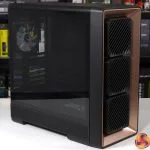
Three front fans that tilt individually give the Formula V Line Air Power G10 a feature you can spot across the room. The practical payoff is less clear: testing found the case cooled reasonably well, but changing the fans’ angle made little difference. At $99.99, its appeal rests on the unusual front panel and flexible layout, while thin steel and fiddly screws make the rest of the case harder to recommend on features alone.

The fans can angle upward or downward by as much as 10 degrees, with stops to hold their position. That gives builders some control over where intake air points, but the review found no meaningful thermal advantage from adjusting them. The concept is visually distinctive; its effect on cooling appears modest.


A flexible chassis with an unusual front
Behind the front assembly, the Air Power G10 offers a fairly adaptable foundation. It supports ATX, Micro-ATX and Mini-ITX motherboards, including rear-connection designs, and its power supply can move between the rear and front of the case. That modular lower chamber gives builders more freedom when arranging the interior, though moving components around also means working with the case’s small, fiddly screws.
The removable lower fan bracket is intended to make fan installation and maintenance easier. There’s also a built-in GPU support that adjusts vertically to suit cards of different thicknesses. Those are useful touches in a case expected to house large components, including the test system’s Palit RTX 5080 Gamerock OC 16GB.
Cooling support includes three 120mm fans at the front and one 120mm rear exhaust fan in the box. The front mounts take three 120mm fans; the roof can fit three 120mm or two 140mm fans; the side supports two 120mm or 140mm fans; and the rear accepts one 120mm or 140mm fan. Two 120mm fans can also go in the floor. A 360mm radiator fits at the top, giving liquid-cooling builders a substantial radiator option.

The case has dust filters at the front, top and bottom. However, the review flags openings around the edges of the three front fans that aren’t filtered. So the supplied filters don’t cover every route air can take into the front assembly.


What the testing says about the tilted fans
The reviewer tested the case with an Intel Core Ultra 7 270K Plus processor, a Formula V Line Ice Jet Vision 360 BK cooler and a Palit RTX 5080 Gamerock OC 16GB graphics card. The rest of the system included a Gigabyte Z890 Aorus Pro Ice motherboard, 48GB of Corsair Vengeance RGB DDR5-8400 memory, a Fractal Design Ion 3 Gold 1000W power supply and a Crucial T700 Pro Gen 5 M.2 NVMe SSD, running Windows 11.
Several thermal runs examined whether the pivoting front fans changed temperatures. The reported takeaway was straightforward: the Air Power G10 works reasonably well, but angling those fans didn’t produce anything notable. The review doesn’t supply specific temperature figures in the article text, so there’s no basis here for comparing numerical results with another case. What the tests do support is a more limited conclusion: the adjustment is an interesting option, but it wasn’t shown to improve cooling.
That distinction matters if you’re choosing a case for a high heat system. The G10’s range of fan positions and radiator support offer room to configure cooling, but the unusual movement itself shouldn’t be treated as evidence of better temperatures. Buyers who simply want a striking front panel may enjoy the mechanism; those focused on cooling gains have little reason, based on these results, to pay extra attention to it.


Build details temper the design
The front panel is the G10’s defining feature, but the review’s concerns are about the rest of the construction. Its steel panels are thin and flexible, and the screws holding the power supply shroud and fan housing are described as tiny and awkward to handle. Those shortcomings can make routine assembly feel less polished than the case’s distinctive exterior suggests.
Storage is conventional but sufficient for a compact set of drives: there’s room for one 3.5-inch hard drive and two 2.5-inch SSDs, with a quick-release drive bracket. Front connectivity includes two USB 3.0 Type-A ports, one USB 3.1 Type-C port and audio. The case measures 500mm high, 489mm deep and 235mm wide, has seven expansion slots and no 5.25-inch drive bays.
Formula V Line also offers metallic painted panel finishes in Rose Gold and Metallic Silver. The company provides 3D design files for the fan grille panel, giving owners a starting point if they want to design and print a custom look. These options reinforce the G10’s appeal as a case with a specific visual identity, rather than changing what the thermal tests found.

Who should consider the Air Power G10?
At $99.99, the Formula V Line Air Power G10 combines a flexible power supply layout, broad fan mounting options and support for a top-mounted 360mm radiator. Its three individually tilting front fans make it stand apart, and the available finishes and custom grille files add room for personalisation.
But the review’s verdict is cautious: the fan angles didn’t deliver a clear cooling benefit, while the thin panels, awkward screws and unfiltered gaps around the front fans detract from the build. If you’re buying for the front panel’s appearance and want to experiment with airflow direction, the G10 has a clear point of difference. If you expect its moving fans to improve temperatures, the tests give little reason to count on that. At this price, the deciding question is whether the look is worth living with the construction trade-offs.