OpenAI’s TTS Voice Retirement Pushes Audio Publishers to Find Replacements
OpenAI will retire three text-to-speech models in 2027. Six Colors is testing ElevenLabs v4 and checking its audio for missing or altered words.
When a text-to-speech voice becomes part of someone’s daily listening routine, replacing it can be more than a technical switch. Six Colors and read-it-later service Listen Later are both preparing for that change after OpenAI said it will retire three audio models on January 6, 2027: tts-1, tts-hd, and gpt-4o-mini-tts.
That date gives developers time to adapt, but the work has already begun. Six Colors uses one of the models for its Audio Newsletter, and its producer has spent the past week comparing alternatives. The leading candidate is ElevenLabs v4, which has produced good results in testing. Moving to it costs dollars per month instead of pennies, and the new voice won’t be the same one listeners already know.
Accuracy mattered more than sophistication
The Six Colors Audio Newsletter launched about six months ago. Its producer chose an OpenAI voice that seemed less advanced than some alternatives because it reliably read the supplied text without omitting or rewriting material. For a spoken version of a publication, that consistency is central: the audio should contain the words the editors wrote, and no others.
The retirement announcement therefore creates two problems. The first is the practical work of rebuilding a relatively new production setup. The second is finding a replacement that can deliver accurate narration at a sustainable cost. The newsletter’s creator has tested both local tools and services accessed through an API, looking for a voice that fits the job rather than simply sounds polished.
That search has led to a more involved quality check. Six Colors now runs each generated audio file through speech recognition and compares the resulting text with the original. This adds a trip through text-to-speech and back to text, so producing an episode takes extra processing. In return, the workflow can flag missing or invented words, including when the team uses a more sophisticated voice model.
That safeguard matters because fluent delivery can make errors hard to catch by ear. A voice may sound natural while leaving out a phrase or changing the wording. Listening to every file remains useful, but comparing a transcript against the source gives the producer another way to check that the finished narration says what it should.
A familiar voice can become part of the product
Listen Later faces a broader transition. The service turns saved articles into spoken audio, and its business has relied on the OpenAI voices now marked for retirement. Its founder, Yalım, told the Six Colors writer he was upset about the change and the work of replacing the service’s existing voices.
Listeners may also feel the change more personally than a list of model names suggests. People grow accustomed to a voice’s sound, pacing, and delivery through repeated use. A replacement can make familiar listening feel different, even if it performs the same basic task. That can matter for people who use audio to keep up with written material, including Listen Later’s visually impaired customers.
Six Colors was inspired to add its newsletter by Listen Later, which turns saved stories into a podcast. The two services share a dependence on text-to-speech, but their needs are not identical. Six Colors is checking a daily newsletter workflow, while Listen Later must consider how a change affects people who have chosen and used a particular voice over time.
Both voices are available to compare
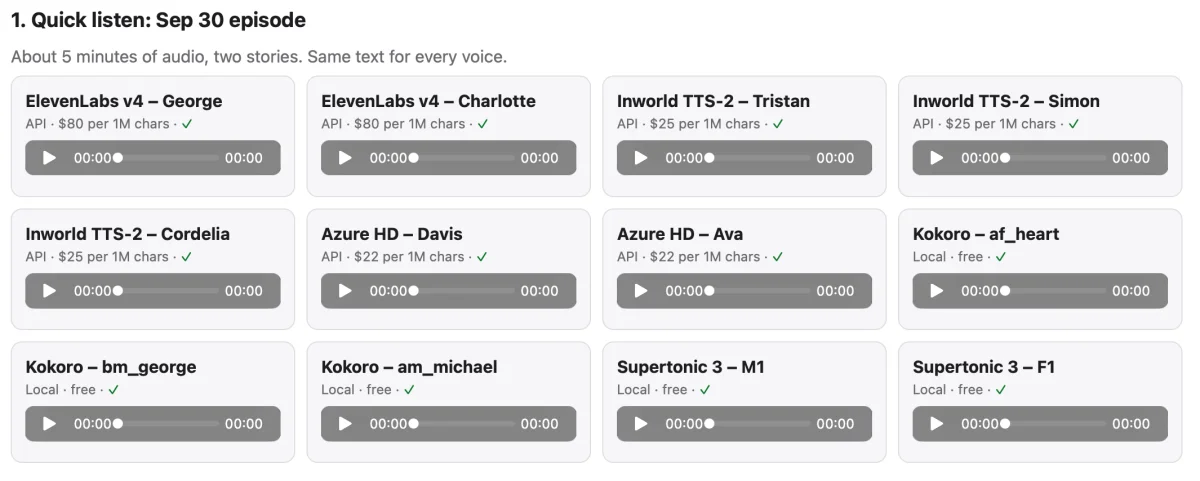
Six Colors is currently running the OpenAI and ElevenLabs versions side by side as a test. Readers can hear an example of the current OpenAI voice and the beta ElevenLabs alternative to compare their sound and delivery. The producer hopes listeners will take to the new voice, though the final choice also depends on accurate reading and the added monthly cost.
The change reaches beyond picking a pleasing narrator. Publishers that build audio features around a third-party model need to account for its accuracy, price, and continued availability, as well as what happens when listeners have become attached to its voice. Six Colors has found a promising replacement in ElevenLabs v4, but its transcript check will remain part of the process. For listeners, the side-by-side recordings offer a chance to hear what may change before the old models go offline.