Qwen4-Max Preview Brings a 1M-Token Window, Credit Pricing and a Short Deadline
Alibaba's Qwen4-Max preview offers a 1M-token context window, but it's Token Plan only, closes November 25, and ships without published benchmarks.
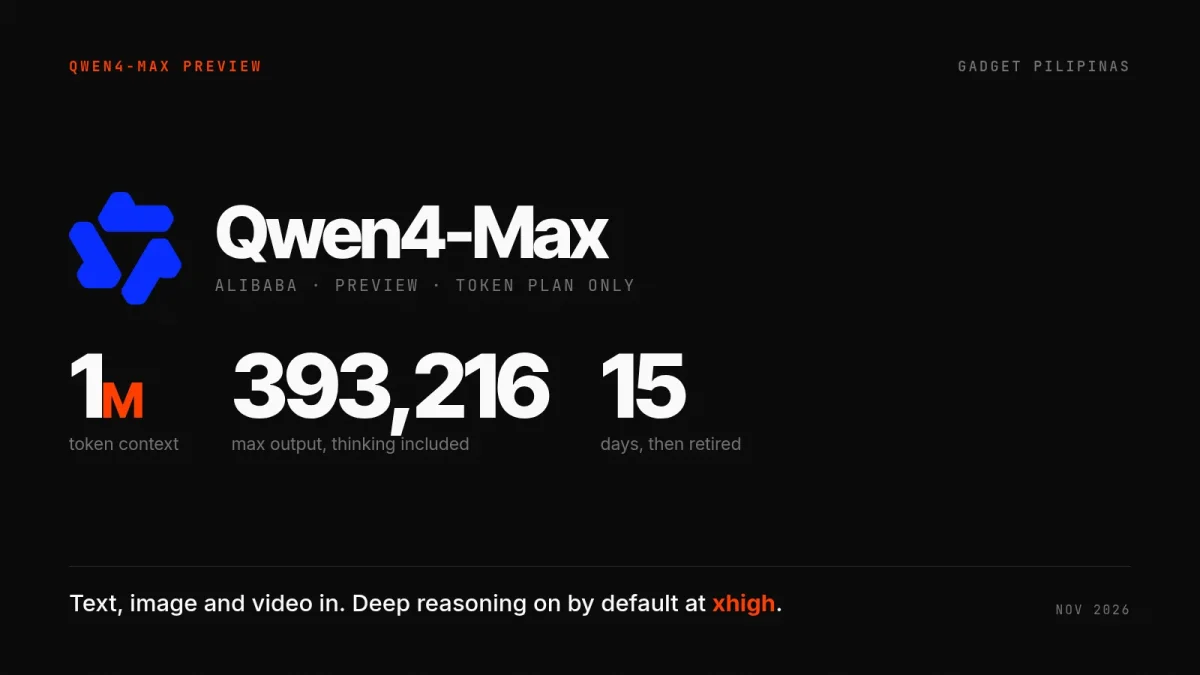
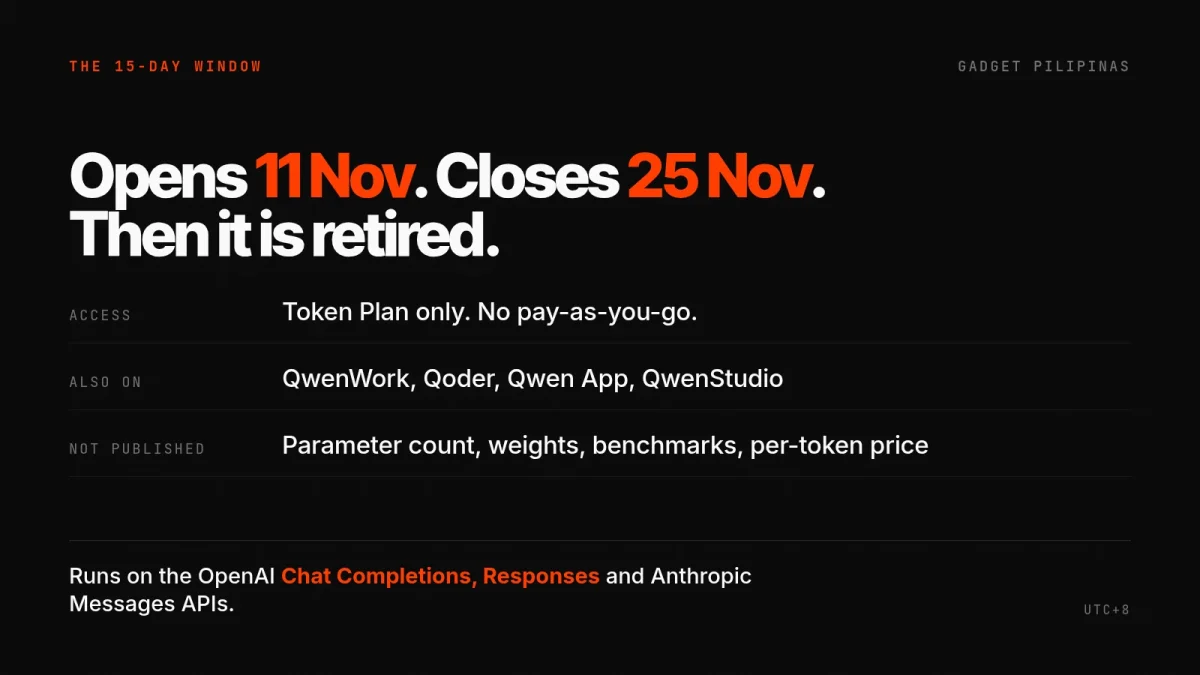
Alibaba's Qwen4-Max is available to developers right now, but the window is short. The preview opened on November 11 through the Token Plan, and Alibaba's own model page says the model will be retired when the preview closes on November 25. If you're evaluating it, treat it as a test bench rather than a foundation.
The Qwen account framed this generation around four goals: deeper knowledge, richer world understanding, stronger coding, and stronger agentic capability. Those are aspirations, not measurements. Alibaba hasn't published a parameter count, released weights, listed a per-token price, or shared a benchmark score. Until independent testers run the model against established suites, any claim about how it compares with rivals is guesswork.
What the spec sheet actually says
Qwen4-Max is a multimodal flagship. It accepts text, images and video as input, and Alibaba positions it for text generation, image and video understanding, and deep reasoning. The target use cases are coding, office productivity, frontend design and multi-step agent tasks.
The headline figure is a 1 million token context window. Output tops out at 393,216 tokens, and that budget is shared between the model's internal thinking and the final answer. That matters in practice. A long reasoning pass can eat into the room left for the reply, so if you're building something that expects long outputs, you'll want to watch how much the model spends thinking before it writes.
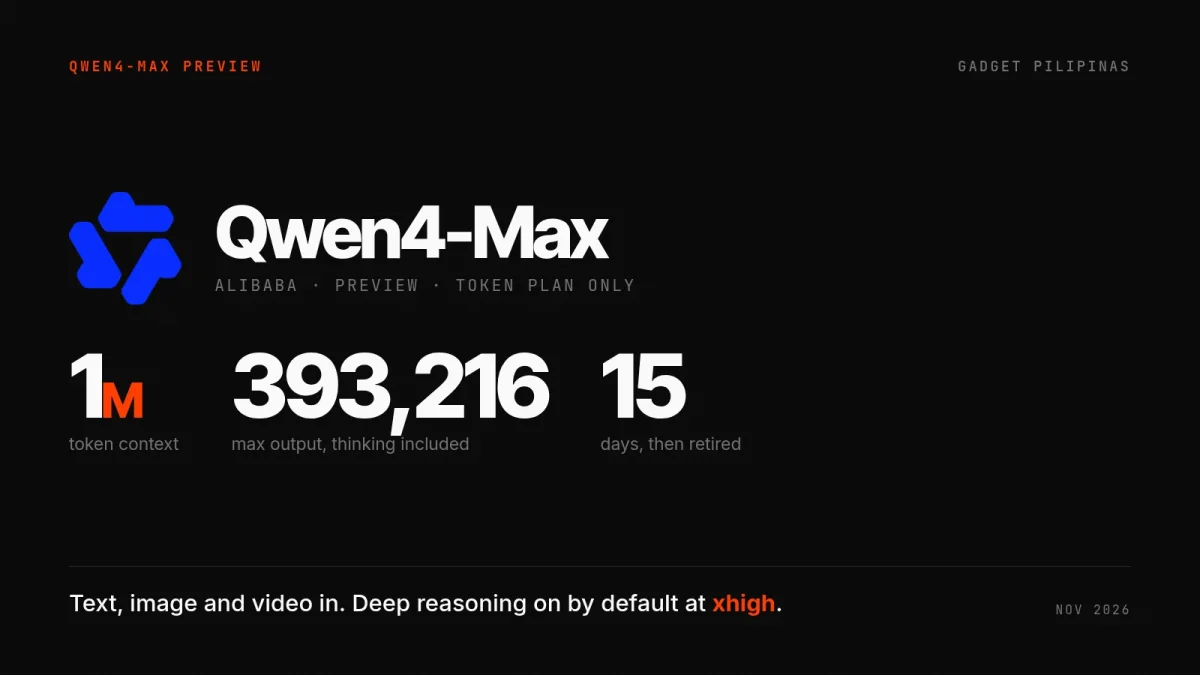
Thinking is on by default, with the reasoning setting at xhigh. You can dial it down with the reasoning_effort parameter, which accepts low, medium or xhigh. The documentation advises against combining that parameter with a separate thinking budget, so pick one control and stick with it. Tool calling covers function calling, web search and built-in tools, and structured outputs support both JSON Object and JSON Schema modes.
The API is designed to feel familiar. Qwen4-Max is compatible with the OpenAI Chat Completions and Responses APIs as well as Anthropic's Messages API. In most cases, that means existing client code and tooling can point at the new endpoint with a configuration change rather than a rewrite. Compatibility at the request level doesn't guarantee identical behaviour, though, especially around reasoning output and tool-call formatting, so run your own regression tests before switching anything live.
Access is the real constraint
Here's the thing: an API key alone won't get you in. Alibaba's documentation says pay-as-you-go access isn't supported during the preview, so you need a Token Plan subscription. The same preview also appears in QwenWork, Qoder, the Qwen app and QwenStudio, which gives non-developers a way to try the model without touching the API.
Pricing works on credits rather than a straight per-token rate. Per the Token Plan overview, credits are drawn at as little as 20 percent of the standard rate during the promotion. Calls made between 22:00 and 08:00 UTC+8 get a further 60 percent off, bringing the effective rate down to 8 percent of standard. That's a steep discount, but it's a time-of-day discount, so it rewards batch jobs and overnight pipelines far more than interactive use.
The model ID is qwen4-max-preview, with an alias of qwen4.0-max-preview. Billing records show the alias, so if you're reconciling usage later, expect to see that name rather than the ID you called.
Why the retirement date matters more than the specs
A model that switches off after two weeks is a fine candidate for evaluation and a poor one for production. My read is that this preview is best used to answer narrow questions: does the 1M window hold up on your real documents, does the reasoning default produce answers worth the token spend, and do your existing tools behave under the compatibility layer? Build those tests now and keep your current model as the fallback.
The lack of published benchmarks makes that testing more important. Without a vendor score to anchor expectations, your own task set is the only reliable yardstick.
A cryptic tease and an open timeline
The launch was preceded by a deliberately vague teaser. On November 6, the Qwen team posted a poster showing birds gathering over a dark sea and forming the shape of a fish, paired with a classical Chinese line that stops one character short: 北冥有鱼,其名为 _. The missing character is 鲲, Kun, the giant fish from Zhuangzi that transforms into a bird. The poster carried three English words, "The becoming begins," and no model name, date or spec. It was a clever piece of marketing, and it also left everyone guessing until launch day.
The Qwen model changelog lists the preview as live. Alibaba hasn't announced a date for a wider Qwen4 release, and the other tiers in the family haven't been detailed. Anyone planning around a broader rollout should wait for those specifics rather than assume a timeline.
For readers in the Philippines, the practical detail is timing. The preview closes at midnight UTC+8 on November 25. If you want the deepest discount, schedule your heavier calls for the 22:00 to 08:00 UTC+8 window, which falls outside Philippine working hours. Whether the model earns a place in your toolkit will depend on what your own tests show once the preview is in your hands, and the clock on this one isn't waiting.